
When Karuna’s KarXT won FDA approval last year, it validated a counterintuitive principle in drug development: sometimes the best way to make a drug work isn’t to change the drug itself—it’s to add a second one that blocks it everywhere except where you need it. That insight, along with the journeys of two other 2024 approvals, captures what makes drug development both maddeningly difficult and occasionally brilliant.
KarXT (Cobenfy): Clever Problem-Solving
KarXT is perhaps the cleverest therapeutic I’ve encountered—a fixed-dose combination that pairs xanomeline, a promising antipsychotic shelved 20 years ago due to severe gastrointestinal side effects, with trospium, a drug that counteracts xanomeline’s peripheral effects but cannot cross the blood-brain 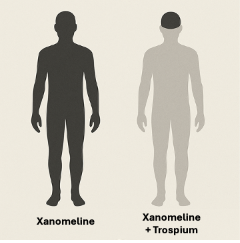 barrier. The result: xanomeline works only in the brain, exactly where it’s needed for treating schizophrenia.
Bristol Myers Squibb clearly thought the combination was compelling as well—they acquired Karuna for $14 billion in March 2024. KarXT is now the first new schizophrenia therapy in over three decades.
The lesson here matters for anyone building or funding biotech companies: breakthrough innovation doesn’t always require novel chemistry or new biological targets. Sometimes it requires recognizing that existing tools, combined thoughtfully, can solve problems that stumped previous generations. KarXT succeeded not because Karuna invented something new, but because they saw a solution others had missed.
Imetelstat (Rytelo): Dogged (but Thoughtful) Persistence
If KarXT demonstrates the power of cleverness, imetelstat—a telomerase inhibitor—represents something equally valuable but far more expensive: persistence.
Telomerase inhibition is a mechanism I never thought would reach patients. Telomerase maintains telomeres, the protective caps on chromosome ends that shorten with each cell division. Blocking telomerase sounds like it should work in cancer with its hallmark uncontrolled growth. But here’s the problem: at any given time, only a small fraction of tumor cells will have reached critically short telomeres and become vulnerable to telomerase inhibition. The rest of the tumor would keep dividing, unaffected.
It took Geron 18 years and approximately 15 clinical studies to figure out where telomerase inhibition works: slower-growing blood cancers like myelodysplastic syndrome (MDS) and myelofibrosis, where the drug has time to control tumor growth as cells gradually reach their telomere limits. The development history tells the story—Geron initially pursued solid tumors and aggressive blood cancers like myeloma, and was in the clinic for 7 years before finally seeing activity in 18 patients with essential thrombocytopenia. The efficacy signal led to a partnership with J&J, which designed and initially ran the registrational MDS trial that secured imetelstat’s approval.
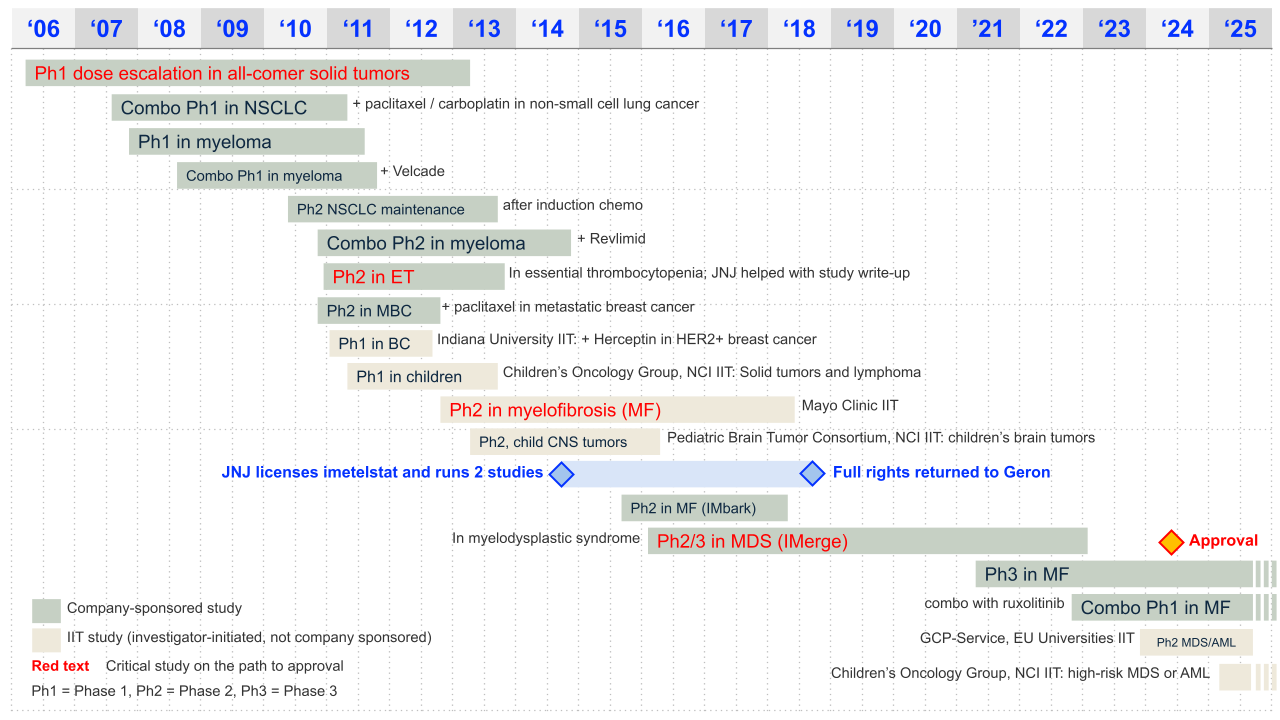
MDS is a smaller market than the original solid tumor ambitions, though still expected to reach ~$1.3B in peak sales. But the 18-year timeline consumed enormous capital. The question is whether MDS could have been identified earlier? And more generally, can we build frameworks to accelerate such insights and pivots? Because most companies don’t have 18 years of runway
Yorvipath: Efficient Development
My final pick is Yorvipath, developed by Ascendis—and it’s here because sometimes the best drug development story is the one that goes exactly according to plan.
Yorvipath is a PEGylated parathyroid hormone (PTH) for patients who lack it, providing steady PTH levels through once-daily dosing, counteracting the body’s normal rapid clearance. It’s hormonal replacement therapy for a “rare” disease that affects 70-80K US patients—a sizable market for a lifelong, chronically dosed drug, with projections exceeding $3B in annual revenue.
But what impresses me as a former drug developer is the clinical efficiency. Between the Phase 1 study in healthy volunteers and the final Phase 3 in hypoparathyroid patients, Ascendis dosed just 267 patients total. The Phase 3 enrolled only 76 patients, compared to the typical Phase 3 range of 250-600. And because PTH directly modulates serum calcium, Ascendis had proof-of-concept within 1-2 weeks of dosing, even in healthy volunteers.
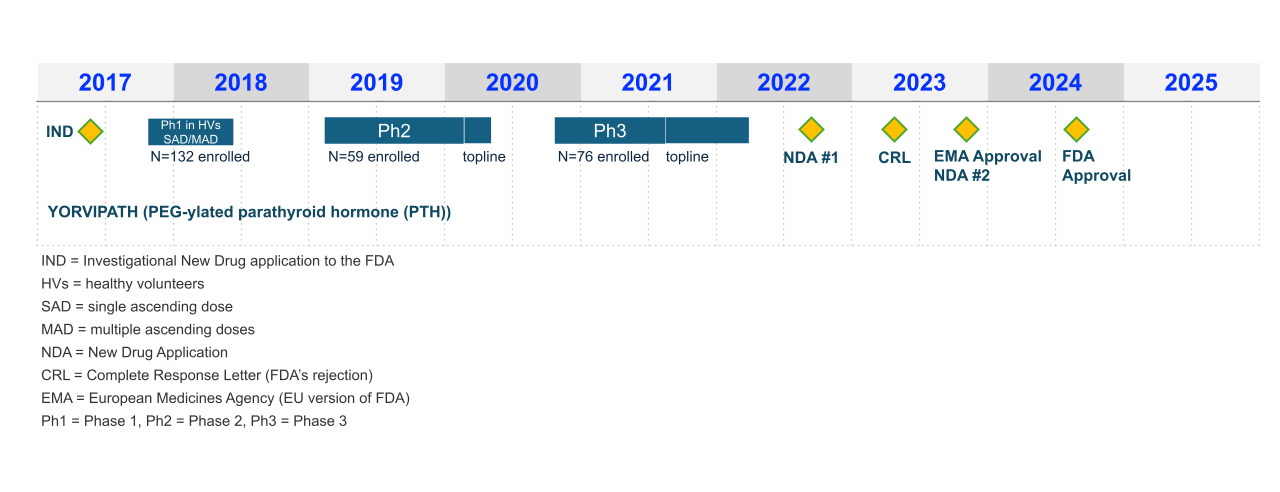
This is the biotech investor dream—a clear disease mechanism, a fast biomarker readout directly linked to clinical activity, and a path to approval that doesn’t require hundreds of millions in capital. Yorvipath delivered on all counts. The challenge is that Yorvipath’s straightforward PTH replacement represents a rare confluence of factors that most programs don’t enjoy.
(Ascendis did hit a manufacturing hiccup that delayed US approval by about a year—a reminder that even well-executed programs don’t always go exactly according to plan.)
What These Approvals Tell Us
These three drugs capture some of what drug development requires: creativity, persistence tempered by willingness to pivot when data calls for it, and disciplined execution.
The hard part is that the path is rarely clear. KarXT’s solution looks obvious in retrospect, but xanomeline sat on the shelf for two decades. Imetelstat eventually succeeded, but what if Geron had run out of capital at year 15? Yorvipath benefited from straightforward biology, but how often is that the case? Yet they all made it and are on their way to become transformative medicines. The challenge for investors and entrepreneurs is recognizing that it’s not one or another path—any success in biotech is going to require some combination of creativity, persistence, data-driven flexibility, and uncompromising execution. There’s no room for error.
2024 Approvals – CBER: https://www.fda.gov/vaccines-blood-biologics/development-approval-process-cber/2024-biological-license-application-approvals
2024 Approvals – CDER: https://www.fda.gov/drugs/novel-drug-approvals-fda/novel-drug-approvals-2024
Geron’s clinical studies of imetelstat (GRN163L): https://www.clinicaltrials.gov/search?intr=GRN163L&sort=StudyFirstPostDate&page=1&limit=25
Geron’s press releases and publications:
Imetelstat IIT in MF, NEJM 2015 (https://www.nejm.org/doi/pdf/10.1056/NEJMoa1310523)
Imetelstat Ph2 in ET, NEJM 2015 (https://www.nejm.org/doi/pdf/10.1056/NEJMoa1503479)
Ascendis forms F-20 on www.sec.gov